7 Types of AI Agents
At GTC 2026, Jensen Huang projected the agentic AI economy would reach $1 trillion. Alibaba launched Wukong. Salesforce Agentforce crossed $800M in revenue. 74% of companies plan agentic deployment in two years — yet only 20% have governance in place. Here are the seven architectures that matter, and what each one means for your organization.
The Story: One Agent Changed Everything for a 200-Person Company
Last quarter, the COO of a mid-market fintech company sat down with her team to audit how they spent their time. The results were uncomfortable. Across the executive staff, 23% of productive hours were consumed by coordination — scheduling meetings, routing requests, compiling reports from multiple systems, and triaging internal support tickets. Not strategic work. Not decision-making. Logistics.
She deployed three types of AI agents over 90 days. A human-in-the-loop agent (Type 6) handled meeting scheduling through ZARA (Zero-friction AI Scheduling and Routing Agent) AI, reducing coordination time by 95%. A router agent (Type 5) triaged internal IT tickets, cutting resolution time by 40%. A human-in-the-loop agent (Type 6) prepared board materials — gathering data, drafting summaries, formatting decks — with the EA reviewing and approving before anything went out.
The result: her team reclaimed 47 hours per week of executive time. Not by working harder. By understanding which agent architecture matched which problem.
That is the gap this article closes. Not "should we use AI?" — that question is settled. The question is: which type of AI agent for which workflow?
Seven Architectures, One Framework for Decision-Making
AI agents are not a monolith. They come in seven distinct architectural patterns, each with different capabilities, complexity levels, and risk profiles. The leaders making the biggest gains in 2026 are not using the most advanced pattern — they are matching the right pattern to each workflow.
- Types 1-2 (Basic + MCP): Low complexity, immediate ROI — start here for scheduling, CRM updates, and data retrieval
- Types 3-4 (Sequential + Parallel): Medium complexity — for multi-step pipelines and speed-critical multi-source workflows
- Types 5-6 (Router + Human-in-Loop): Medium-high — for heterogeneous inputs and high-stakes decisions
- Type 7 (Dynamic Spawner): Highest complexity — for open-ended strategy and research where no fixed pipeline works
The platform matters less than the pattern. These architectures apply whether you are working with OpenAI, Google Gemini, Anthropic Claude, or open-source models.
The Agentic AI Economy in 2026
of companies plan agentic AI deployment in 2 years (Deloitte)
of enterprise apps will include agents by end of 2026 (Gartner)
projected agentic AI market (Jensen Huang, GTC 2026)
avg AI scheduling time with Zara — a Type 6 agent in production
“We've moved past the era of single-purpose agents. 2026 is the breakthrough year for multi-agent systems, where specialised agents collaborate under central coordination.”
Agent Complexity at a Glance
Types 1-2: Start Here
Basic agents with tools and MCP servers. Low complexity, immediate ROI. Perfect for scheduling, CRM, and data retrieval.
Types 3-4: Scale Up
Sequential and parallel agents. Medium complexity. For content pipelines, research, competitive intelligence, and reporting.
Types 5-6: Govern
Router and human-in-the-loop agents. For support triage, financial actions, and any high-stakes workflow needing human approval.
Type 7: Orchestrate
Dynamic subagent spawners. Highest power and complexity. For open-ended strategy, incident response, and complex procurement.
See a Type 6 Agent in Production
Zara AI is a human-in-the-loop scheduling agent used by teams at companies like Unified Global, Razormetrics, and Marl Accelerators. See how it works.
Request a DemoWhy Every Leader Needs an AI Agent Architecture Map in 2026
At GTC 2026 last week, NVIDIA CEO Jensen Huang made a statement that stopped a lot of executives mid-coffee: he projected the agentic AI economy would reach $1 trillion in value, and suggested it was already underway. He was not speaking about chatbots. He was speaking about autonomous software agents that perceive, reason, and act on behalf of your business — without a human in the loop for every step.
Within days, Alibaba launched Wukong, an enterprise agent platform capable of managing document workflows, approvals, and research simultaneously. Salesforce announced its Agentforce platform had crossed $800 million in annual revenue. And Deloitte released data showing that nearly three in four companies plan to deploy agentic AI in the next two years, yet only one in five have any governance model in place for those agents.
The gap between ambition and understanding is wide. The leaders who close it first will have an extraordinary structural advantage. The seven architectures below are not a roadmap to follow in sequence — they are a toolkit. Understanding which pattern matches which problem is the single most leveraged decision a leader can make about AI in 2026.
Basic Agents with Tools — Where Most AI Deployments Start
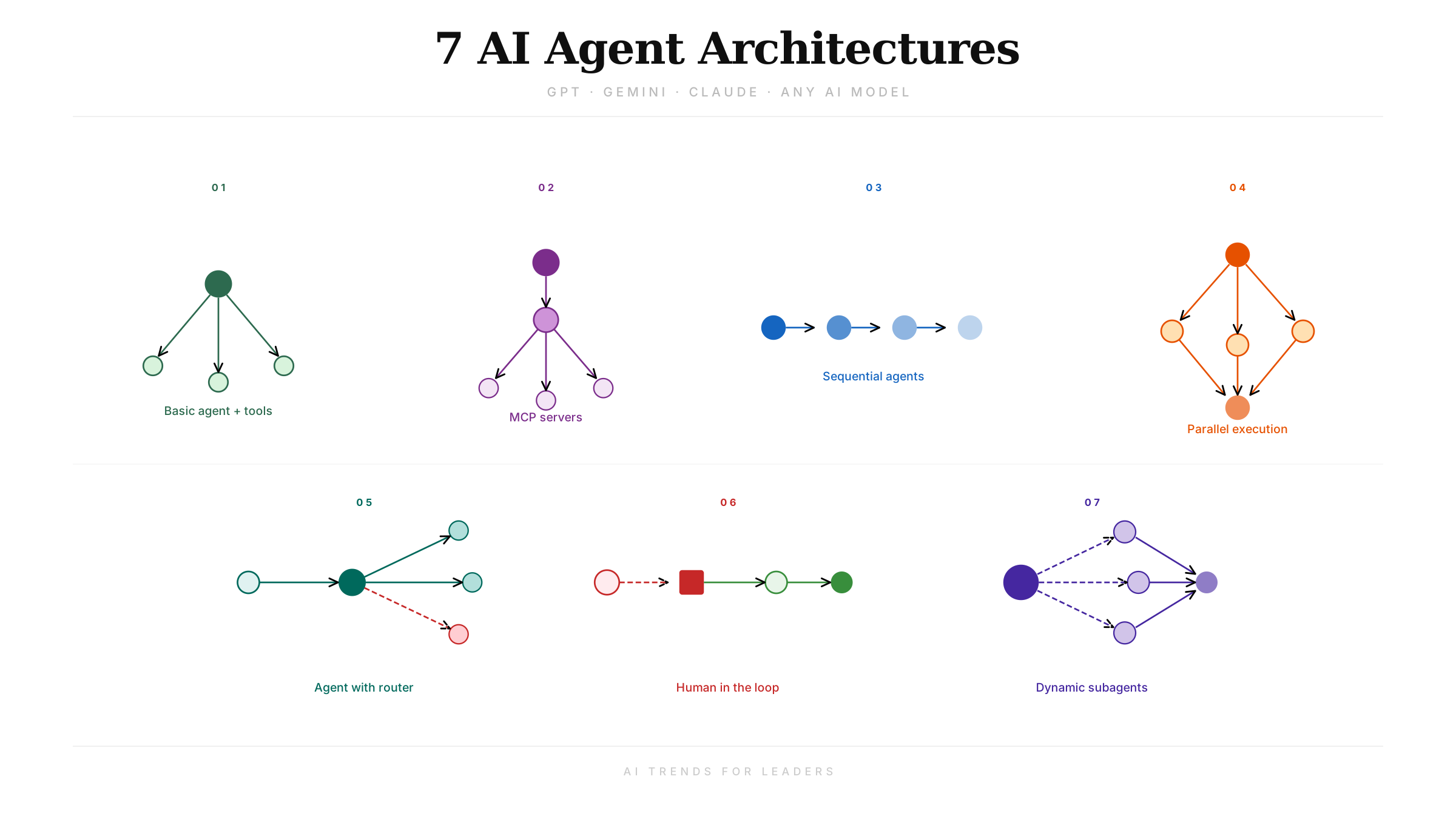
Type 1: Basic Agent with Tools — A single large language model (GPT-4o, Gemini 1.5, Claude, or comparable) is given access to a set of tools it can invoke: a calendar API, a CRM, a search engine, a code interpreter. The model decides autonomously when to call which tool, interprets the result, and continues reasoning until the task is complete.
Think of it as hiring a very capable assistant and handing them a set of logins. They can plan and execute tasks without asking you how to open each app. This is the architecture powering the majority of AI assistants you see today — from Microsoft Copilot reading your inbox to Zara AI finding free slots across five time zones.
Type 2: Agent with MCP Servers — The Model Context Protocol (MCP) is an open standard that gives any AI agent a consistent interface for connecting to any external service. Instead of writing custom integrations for each tool, you connect the agent to an MCP server that handles authentication, formatting, and communication with Notion, Jira, Salesforce, or your internal databases.
The strategic implication: MCP turns individual AI models into universal operators across your entire software stack. A single agent can read your project management data, update your CRM, and query your analytics warehouse in one continuous reasoning loop. MCP is fast becoming the plumbing standard of the agentic enterprise.
Leader's takeaway: Start here. Map which repetitive, tool-heavy workflows consume the most human hours. A basic agent can handle 60-70% of those tasks within weeks of deployment, with minimal infrastructure overhead. Ask your engineering team whether your critical software stack is MCP-compatible.
Sequential and Parallel Agents — Scaling AI Workflows
Type 3: Sequential Agents — A chain of specialised models, each with a defined role. Agent A gathers context. Agent B uses that context to produce a draft. Agent C formats the output. Agent D sends it. Each agent receives the previous agent's output as its input, like an assembly line where each station adds value.
The power of this pattern is specialisation. A model fine-tuned for research is better at research than a generalist model asked to do everything. The risk is propagation: if Agent B misinterprets Agent A's output, everything downstream is corrupted. Schema contracts between stages — explicit, typed agreements about what one agent hands to the next — are essential.
Type 4: Parallel Execution Agents — When tasks are independent and time matters, a dispatcher breaks a problem into subtasks, sends each to a separate agent running simultaneously, and an aggregator merges the results.
A practical example: a competitive intelligence brief that used to take a senior analyst two days. With parallel agents, one agent scans earnings calls, another monitors press releases, a third analyses social sentiment, and a fourth checks patent filings — all at the same time. The aggregator synthesises a structured report in minutes.
Gartner data shows customer service agents using parallel architectures are saving teams 40+ hours monthly. Finance teams deploying parallel agents for forecasting and audit are accelerating close processes by 30-50%.
Leader's takeaway: Sequential agents excel at multi-step content and data workflows (financial reporting, proposal drafting, compliance summaries). Parallel agents are for any workflow where multiple independent data sources need to be consulted before a decision — intelligence gathering, due diligence, multi-market analysis.
Router Agents and AI Traffic Control
Type 5: Agents with Routers — Not every input deserves the same response pathway. A router agent — an intent classifier combined with a dispatcher — analyses incoming requests and directs them to the workflow best suited to handle them.
A customer support system using this pattern might route billing queries to a finance-focused agent, technical queries to a product knowledge agent, and escalation requests to a human handoff workflow. The router can be rule-based, trained on historical data, or powered by its own LLM call that reasons about intent.
The failure mode engineers call "silent misrouting" is the critical risk: the system appears to work but sends queries to the wrong workflow without triggering any visible error. Observability and logging are not optional in this architecture — they are foundational.
Any system receiving heterogeneous inputs at scale is a natural candidate — customer service, internal IT helpdesks, sales qualification pipelines, and Microsoft Teams or Slack channels where requests of mixed types flow in continuously.
Leader's takeaway: The router is your first line of operational control over what AI does and does not handle autonomously. Before deploying, define your routing taxonomy, invest in logging, and test with adversarial inputs that deliberately try to confuse the classifier.
Human-in-the-Loop Agents — AI Governance in Practice
Type 6: Human-in-the-Loop Agent — This is the architecture that boards and risk officers should understand first. The agent performs all the thinking: it gathers context, runs calculations, drafts proposals, and prepares actions. But before executing anything consequential, it pauses and routes to a human for approval.
Deloitte's 2026 data is instructive: nearly three in four companies plan agentic deployments, but only one in five have a governance model ready. Human-in-the-loop is that governance model in code. It is not a workaround for imperfect AI — it is a deliberate architectural decision that preserves human judgement for the decisions that deserve it.
Zara AI from TEAMCAL AI is a production example of this pattern. Zara does all the heavy lifting: she checks calendars, coordinates across time zones, handles the back-and-forth with attendees, and prepares a fully confirmed meeting. But before anything gets committed to the calendar, the executive assistant reviews and approves. That approval gate is the design, not a limitation. Scheduling on behalf of a senior leader carries real stakes — a wrong time, a missed conflict, an uninvited attendee — and the human gate ensures accountability stays with the person who understands the full context.
The design challenge is calibration: requiring approval on every action creates fatigue that leads to rubber-stamping. Zero oversight creates liability. The framework: irreversible actions and actions above a defined risk threshold trigger the human gate. Everything else executes automatically.
Leader's takeaway: Define your approval matrix before deploying any agents in production. Map actions to reversibility and risk level. This is governance, not friction.
Dynamic Subagent Spawners — The Most Powerful Pattern
Type 7: Dynamic Subagent Spawner — The most architecturally sophisticated and most powerful pattern. A central orchestrator LLM is given a high-level objective and no fixed plan for achieving it. As it reasons, it identifies what specialised capabilities it needs, consults an agent registry, and dynamically spawns subagents to handle specific tasks. The topology of the system — who does what — is determined at runtime, not at design time.
IBM's chief architect described this as the key inflection point in enterprise AI: the shift from single-purpose agents (2024) to multi-agent systems that collaborate under central coordination (2026). In practice, this is the architecture behind the most capable autonomous coding systems, complex research workflows, and what Jensen Huang called "teams of specialised agents" that employees will deploy and manage.
The design constraints are significant. Unbounded spawning can drive unexpected costs. Circular delegation — where agents create loops of responsibility — must be explicitly guarded against. And debugging a failure is hard because the execution path was created dynamically. Observability is not a nice-to-have; it is the only way to reason about what happened after the fact.
Leader's takeaway: Reserve this architecture for genuinely open-ended, high-value problems where no fixed pipeline can anticipate all necessary steps — competitive strategy briefs, complex procurement analysis, or full-stack incident response. Invest in logging and cost guardrails before deploying at scale.
What Leaders Should Do This Quarter
Most enterprise AI deployments in production right now are Type 1 or Type 2 agents. Most of the organisations making outsized gains in 2026 are moving toward Types 3-5. The organisations that will define the next three years are already experimenting with Types 6 and 7.
The three decisions that matter most right now:
- Which workflows have the highest concentration of repetitive, tool-heavy steps that do not require human judgement? Start there with Types 1-2. AI scheduling with Zara is the most common entry point — it delivers measurable ROI within the first week.
- Which multi-step processes lose significant value to handoff friction between human teams? Deploy sequential or parallel patterns (Types 3-4). Financial reporting, proposal drafting, competitive intelligence.
- Which high-stakes decisions need to remain under human control but could be dramatically accelerated by AI preparation? Design the human-in-the-loop gate carefully (Type 6). Board prep, executive support, financial approvals.
One note on governance that Deloitte's data makes unavoidable: before any agent touches a production system, define who owns the approval matrix, what data the agent can access, and what your fallback is if the agent errors. The agent topology determines capability. The governance model determines whether that capability serves the organisation or undermines it.
"A team of three professionals, armed with the right AI agents, can execute the workload that previously required a department of twenty." — Switas Consultancy, March 2026
The leaders who will look back at 2026 as their inflection point are not waiting for perfect models or perfect tooling. They are mapping their workflows, choosing the right architectural pattern for each one, and building the governance infrastructure to run agents responsibly.
Frequently Asked Questions
The seven fundamental AI agent architectures are: (1) Basic Agent with Tools, (2) Agent with MCP Servers, (3) Sequential Agents, (4) Parallel Execution Agents, (5) Agents with Routers, (6) Human-in-the-Loop Agents, and (7) Dynamic Subagent Spawners. Each pattern has different complexity, capability, and risk profiles suited to different business workflows.
Start with Type 1 or Type 2 (Basic Agent with Tools or MCP Agents). These have low complexity and deliver immediate ROI on repetitive, tool-heavy workflows like scheduling, CRM updates, and data retrieval. Most enterprise AI deployments in production today are Types 1-2.
A human-in-the-loop agent (Type 6) performs all the thinking — gathering context, running calculations, drafting proposals — but pauses before executing consequential actions and routes to a human for approval. Zara AI from TEAMCAL AI uses this pattern: it handles all scheduling coordination but an executive assistant reviews and approves before meetings are committed.
MCP is an open standard that gives any AI agent a consistent interface for connecting to any external service. Instead of custom integrations per tool, an MCP server handles authentication and communication with Notion, Jira, Salesforce, databases, etc. It turns individual AI models into universal operators across your software stack.
Zara AI is a Type 6 (human-in-the-loop) scheduling agent. She autonomously checks calendars, coordinates across time zones, handles back-and-forth with attendees, and prepares confirmed meetings — all in an average of 49 seconds. But before anything is committed, the executive assistant reviews and approves. This preserves human accountability while eliminating 90-95% of coordination overhead.
According to Deloitte's 2026 data, 74% of companies plan agentic AI deployment in the next two years. Gartner projects 40% of enterprise applications will include agents by end of 2026. However, only 20% of companies have governance models in place for their agents — a significant gap.
Download the Free AI Operations Guide
Practical frameworks for choosing, deploying, and governing AI agents across your organization.
AI Guide for Operations Leaders
A comprehensive guide to deploying AI agents in your operations workflows — from scheduling to strategic coordination.